

Research outcomes
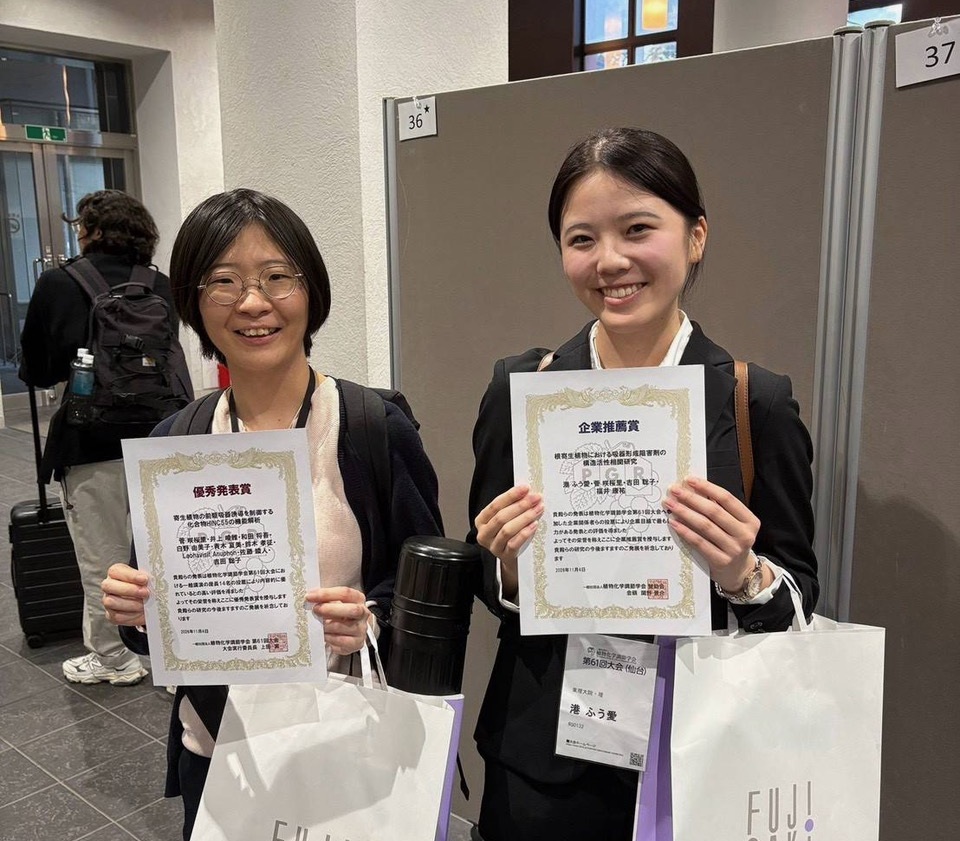
Saori Suga (D3) from the plant symbiosis laboratory has received the Outstanding Presentation Award at the 61th meeting of the The Japanese Society for Chemical Regulation of Plants
Saori Suga (D3) from the plant symbiosis laboratory has received the Outstanding Presentation Award at the 61th meeting of the The Japanese Society for Chemical Regulation of Plants (November 4, 2026).
Comment on the award
I am deeply honored to receive the Outstanding Presentation Award. I am also delighted that my collaborator, Ms. Fua Minato at Tokyo University of Science, received the Corporate Recommendation Award. We are particularly grateful that our research has been recognized from both academic and industrial perspectives. Encouraged by these awards, I hope to further advance our research toward a deeper understanding of the mechanisms underlying plant parasitism.
Award winning research project
Functional analysis of HINC55 in the regulation of prehaustorium induction in parasitic plants
Parasitic weeds belonging to the Orobanchaceae family cause severe damage to crop production worldwide. Parasitic plants develop a specialized organ called a haustorium, which enables them to invade host plant tissues and establish connections with them to acquire nutrients. During the early stages of haustorium development, a structure known as the prehaustorium is induced by host-derived haustorium-inducing factors (HIFs), such as 2,6-dimethoxy-1,4-benzoquinone (DMBQ) and syringic acid. Since prehaustorium formation is a critical initial step in the establishment of parasitism, inhibiting this process is expected to provide a promising strategy for developing novel methods to control parasitic weeds.
In this study, we characterized the biological activity of Haustorium INhibitory Compound 55 (HINC55), a prehaustorium formation inhibitor identified through chemical screening in Orobanchaceae parasitic plants. In the parasitic plant Striga hermonthica, HINC55 inhibited prehaustorium formation induced by DMBQ and syringic acid, whereas it had no effect on cytokinin-induced prehaustorium formation. Furthermore, we found that HINC55 inhibited DMBQ-induced stomatal closure in both Arabidopsis thaliana and Phtheirospermum japonicum. These findings suggest that HINC55 not only inhibits prehaustorium formation in parasitic plants but also acts on the quinone signaling pathway in plants.
※The findings of this study are presented in the following publication.
Saori Suga, Ryoga Inoue, Syogo Wada, Yumiko Shirano, Natsumi Aoki, Takamasa Suzuki, Anuphon Laohavisit, Ayato Sato, Satoko Yoshida, A quinone signaling inhibitor enables functional dissection of haustorium-inducing factors in Orobanchaceae parasitic plants, Plant Physiology, Volume 200, Issue 3, March 2026, kiaf686,
https://doi.org/10.1093/plphys/kiaf686
Laboratory of Plant Symbiosis
https://bsw3.naist.jp/eng/courses/courses113.html
https://bsw3.naist.jp/yoshida/index-en.html
( November 10, 2026 )
